
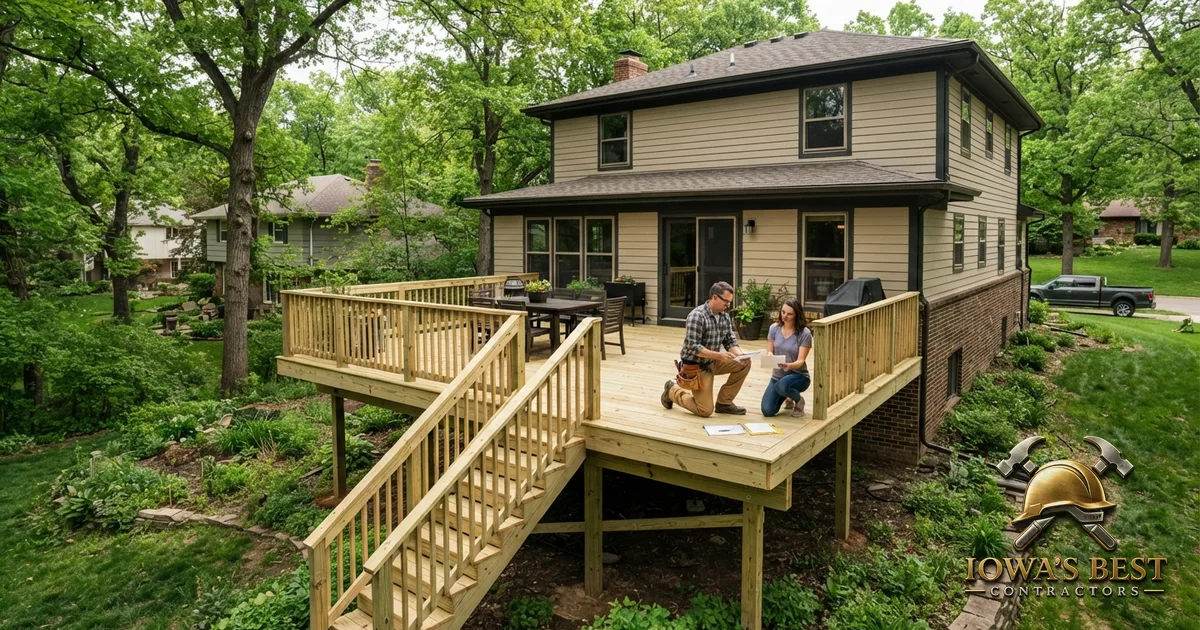
A new deck in Iowa typically costs between $4,500 and $12,000 for a standard pressure-treated wood build, while composite and premium designs commonly run $12,000 to $30,000 or more. The biggest variables are size, material, height off the ground, and whether you add features like stairs, railings, and built-in seating. Most homeowners budget by the square foot: roughly $25 to $60 for treated wood and $40 to $90 for composite, installed.
How much does each deck material cost in Iowa?
Material choice sets the tone for your whole budget and for how much maintenance you sign up for.
- Pressure-treated wood ($25-$45 per sq ft): The most affordable and most common in Iowa. Durable and easy to work with, but needs regular sealing to survive freeze-thaw and humidity.
- Cedar or redwood ($30-$55 per sq ft): Naturally rot-resistant with a warm look, still requiring periodic maintenance.
- Composite and PVC ($40-$90 per sq ft): Higher upfront cost but very low maintenance, which appeals to many Iowa homeowners tired of resealing wood every couple of years.
A simple ground-level 12-by-16-foot treated deck sits near the low end. Add a second story, wrap-around design, custom railings, or a pergola and you move quickly toward the higher ranges. Costs vary by contractor, site conditions, and season.
What drives the price beyond material
Several factors influence the final number as much as decking boards do.
Height and structure: A deck several feet off the ground needs more posts, deeper footings, and railings, all of which add labor and material. Ground-level platforms are cheaper.
Footings and frost depth: This is a big one in Iowa. Deck footings must extend below the frost line, which is generally around 42 inches in much of the state, so they do not heave during freeze-thaw. Digging and pouring proper footings is essential and adds cost, but skipping it leads to a deck that shifts and fails.
Stairs, railings, and features: Each stairway, railing run, and built-in feature adds labor. Lighting, benches, and privacy screens all raise the total.
Site access and grading: Sloped or hard-to-reach yards, common around the bluffs near Council Bluffs and Dubuque, increase labor.
Permit rules in Iowa
Most Iowa cities require a building permit for a new deck, especially one attached to the house or above a certain height, often 30 inches off grade. Permit requirements and fees vary between jurisdictions in Polk, Linn, and Scott counties, so always confirm with your local building department before work begins.
Permits exist to make sure the deck is structurally sound, with proper footings, ledger attachment, and railing heights. A registered contractor will pull the permit and schedule inspections as part of the job. If a builder suggests skipping the permit to save time or money, treat that as a warning sign.
As of this guide's September 2026 update, the weakest point of most Iowa decks is the ledger board, where the deck attaches to the house: a poorly flashed or under-fastened ledger is one of the most common causes of deck failure, and it lets water into the rim joist of the home. Footings have to reach below Iowa's frost line, permit rules are set by your city or county rather than the State, and a deck attached to the house usually needs one, so call the local building department before you dig. Get itemized bids that name the footing depth, the ledger flashing and fasteners and the decking material, and confirm each contractor is registered with the State of Iowa under chapter 91C.
Iowa climate and durability
Iowa's freeze-thaw cycles, humid summers, and hard winters are demanding on outdoor structures. Beyond deep footings, choose fasteners and hardware rated for exterior use, and plan to seal wood decks regularly. Composite decking sidesteps much of the sealing work but still needs proper structural framing underneath, which is always pressure-treated lumber regardless of the surface material.
How do I choose a deck contractor in Iowa?
Deck building sits within general remodeling and carpentry. As of the September 2026 registry snapshot, Iowa has 3,413 registered residential remodelers and another 1,787 registered specialty-trade contractors, the bucket that includes many dedicated deck and fence builders, so in most cities you have real choices. Look for a contractor who builds decks regularly, provides a written scope with the footing and framing details spelled out, and handles the permit. You can browse registered residential remodelers statewide, see specialty-trade contractors, or start from your own town, remodelers in Davenport, for example.
Every contractor in our directory comes from Iowa's state registration record under chapter 91C, with no paid inclusion. Registration is not a license or an endorsement, so always review past decks and references, and check the registration against the State's own record before you sign.
How many specialty trade contractors are registered in Iowa?
As of September 2026, 1,787 contractors are registered with the State of Iowa under the trade All Other Specialty Trade Contractors. The largest concentrations are in Des Moines (128), Cedar Rapids (63), Sioux City (37), West Des Moines (33), Ankeny (27). The statewide list covers every county, alphabetically, straight from the public record.
Registration is a compliance record with the State, not a rating of quality, so use the list to build a shortlist and compare itemized bids from at least three of them.
Frequently asked questions
Do I need a permit to build a deck in Iowa?
Most cities require one for attached decks or decks above roughly 30 inches. Requirements vary by jurisdiction, so confirm with your local building department. A registered contractor typically handles this for you.
How deep do deck footings need to be in Iowa?
Footings generally must reach below the frost line, around 42 inches in much of Iowa, to prevent heaving. Your local code sets the exact depth.
Is composite decking worth the extra cost?
For many Iowa homeowners, yes. The higher upfront price buys much lower maintenance, no annual sealing, and strong resistance to the state's freeze-thaw and humidity. Wood remains the budget-friendly choice if you do not mind upkeep.
How long does it take to build a deck?
A straightforward deck often takes one to two weeks once permits are approved and materials arrive. Larger or elevated designs take longer.
Who builds decks in Iowa?
Deck work is done by registered residential remodelers, finish carpenters, and specialty-trade contractors. Iowa's registry counts 3,413 remodelers and 1,787 specialty-trade contractors as of September 2026, all listed here with their registration numbers, so you can confirm any builder is currently registered before hiring.
Ready to compare real quotes? The only deck price that matters is a bid on your yard, your height, your material. Collect bids from registered contractors free, describe the deck once and let registered Iowa builders come to you with competing numbers.