
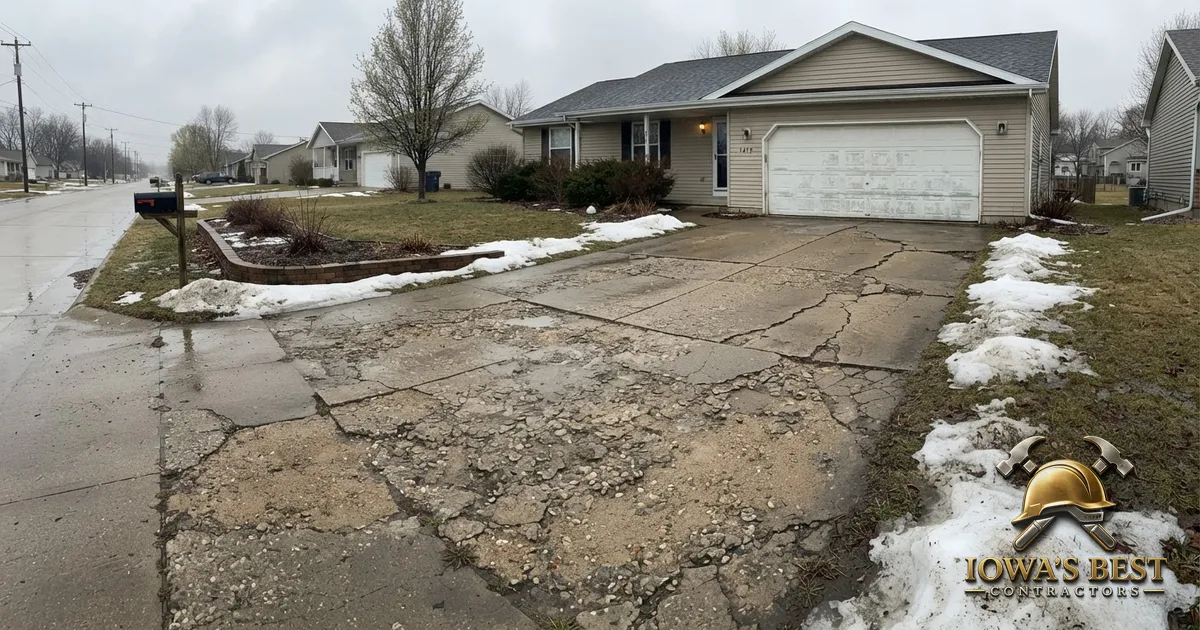
Resurfacing works for surface cracks and minor scaling under ¼ inch deep and costs $2–4 per square foot in Iowa. Full replacement is needed when you see wide cracks, sinking sections, or deep freeze-thaw damage, typically running $8–15 per square foot as of September 2026.
How does Iowa weather damage driveways?
Iowa's freeze-thaw cycles are brutal on concrete and asphalt. Water seeps into small cracks, freezes, expands, and breaks the surface apart. A single winter can turn hairline cracks into deep fissures. De-icing salt accelerates the process by pulling more moisture into the concrete and causing surface scaling—that flaky, pitted look you see on older driveways. Poor drainage compounds the problem: standing water has more time to penetrate and freeze. Most Iowa driveways show visible damage within 10–15 years, and the question becomes whether a repair will hold or you're just delaying the inevitable replacement.
When does resurfacing make sense for an Iowa driveway?
Resurfacing (also called overlay or topping) works when the damage is cosmetic and the underlying slab is still solid. You're looking at surface cracks under ¼ inch wide, minor scaling, and no major settling or heaving. A contractor grinds down the old surface, applies a bonding agent, and pours a thin layer of new concrete—typically 1–2 inches. This hides the damage and adds a few years of life. Resurfacing costs $2–4 per square foot in Iowa as of September 2026, so a standard two-car driveway (about 600 square feet) runs $1,200–2,400. It's a budget-friendly option if you plan to sell within five years or the base is genuinely sound. The catch: if the underlying slab shifts or cracks widen, the overlay will crack too, often within a year or two.
Resurfacing an Iowa driveway costs $2–4 per square foot and works only when surface damage is shallow and the base slab remains structurally sound with no major settling, heaving, or cracks wider than ¼ inch. Full replacement at $8–15 per square foot is necessary when freeze-thaw cycles have caused deep cracking, sinking sections, or a compromised base, and it typically lasts 25–30 years with proper installation and sealing, as of September 2026.
When do you need full driveway replacement in Iowa?
Full replacement is the right call when the damage goes beyond the surface. Here's what tells you the base is compromised:
| Sign of damage | What it means | Repair or replace? |
|---|---|---|
| Cracks wider than ¼ inch | Base has shifted or settled | Replace |
| Sinking or heaving sections | Soil erosion or frost heave | Replace |
| Deep spalling (chunks missing) | Freeze-thaw has penetrated | Replace |
| Multiple patches already failing | Underlying issues not addressed | Replace |
| Surface cracks, no settling | Cosmetic only | Resurface |
Replacement means tearing out the old concrete, regrading the base, adding proper compacted gravel, and pouring a new 4–6 inch slab. In Iowa, expect to pay $8–15 per square foot, so that same 600-square-foot driveway costs $4,800–9,000. The wide range depends on site access, whether you need new drainage, and how much base work is required. A good contractor will also slope the driveway away from your foundation and add control joints to manage future cracking. Done right, a new driveway lasts 25–30 years.
What about asphalt driveways in Iowa?
Asphalt is cheaper upfront—$3–7 per square foot installed—but it needs more maintenance in Iowa's climate. Freeze-thaw cycles cause cracking and potholes, and you'll need to seal it every 2–3 years. Resurfacing asphalt (adding a new top layer) costs $2–4 per square foot and works if the base is solid, but asphalt driveways typically need full replacement after 15–20 years. Concrete costs more initially but requires less ongoing work and lasts longer, making it the more common choice for Iowa homeowners planning to stay put.
How do you choose between repair and replacement?
Start by getting a realistic assessment. Walk your driveway and note every crack, sunken spot, and area where water pools. If you see widespread damage or the driveway has already been patched multiple times, replacement is likely the better investment. If damage is isolated to one section, you might replace just that area rather than the whole slab. Get quotes from at least two state-registered contractors—they'll tell you whether the base is salvageable. Ask for references and proof of general liability insurance; registration with the state confirms workers' comp compliance but doesn't guarantee workmanship. A good contractor will explain the grading, drainage plan, and curing process. Avoid anyone who pressures you to decide on the spot or asks for a large deposit upfront—Iowa law limits deposits to one-third of the contract price or $1,000, whichever is less, as explained in our guide to contractor deposit laws.
Search for concrete and paving contractors by trade or by county at Iowa's Best Contractors to compare registered pros near you.
Frequently asked questions
How long does a concrete driveway last in Iowa?
A properly installed concrete driveway in Iowa typically lasts 25–30 years with regular sealing. Freeze-thaw cycles, de-icing salt, and poor drainage can shorten that to 15–20 years. Asphalt driveways last 15–20 years under similar conditions.
Can you resurface a cracked concrete driveway in Iowa?
Yes, if cracks are narrow (under ¼ inch), surface-level, and the slab is still structurally sound. Resurfacing adds a thin overlay that hides cosmetic damage. If the base has shifted or cracks are wide and deep, resurfacing won't hold and you need full replacement.
Do I need a permit to replace my driveway in Iowa?
Most Iowa cities require a permit if you're changing the driveway footprint, adding new drainage, or connecting to a public street. Simple same-footprint replacement often doesn't need one, but check with your city building department before starting work.