
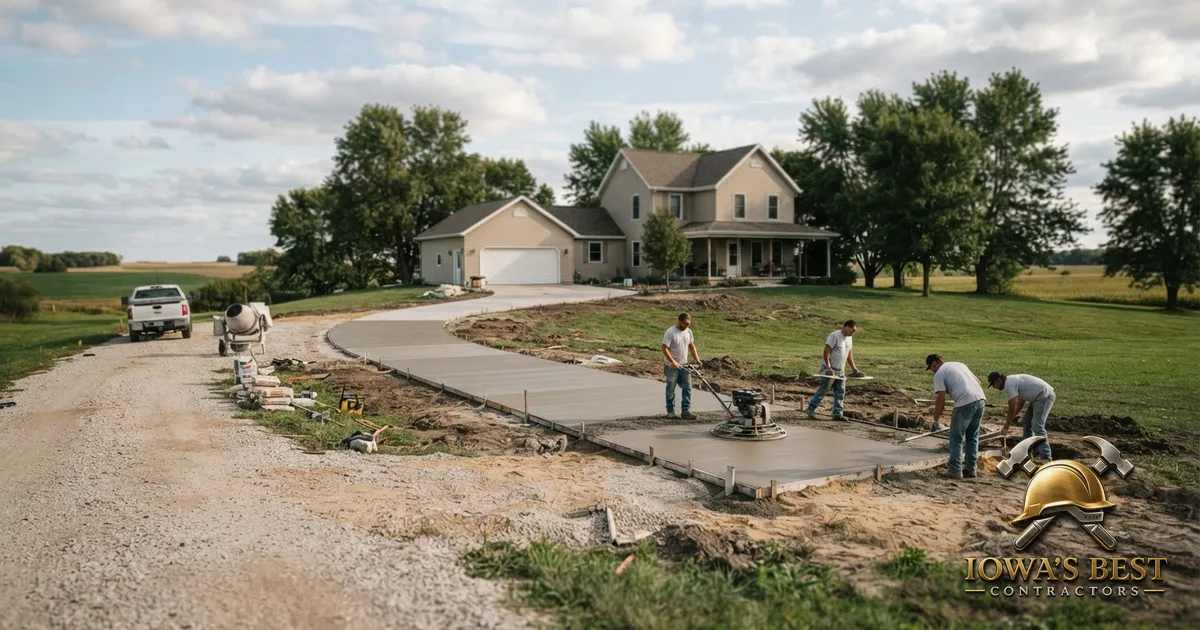
A new concrete driveway in Iowa typically costs between $6 and $12 per square foot, which puts a standard two-car driveway in the $4,500 to $10,000 range. Decorative finishes, thicker slabs, and site prep can push it higher. Concrete costs more up front than gravel or asphalt, but it lasts for decades and stands up well to Iowa winters when it is installed correctly. Here is how to budget and hire smart.
How much does a concrete driveway cost in Iowa?
Concrete flatwork is priced per square foot, and the finish level matters a lot:
- Standard broom-finish concrete: $6 to $9 per square foot. A typical 600-square-foot driveway runs about $4,000 to $5,500.
- Reinforced or thicker slabs (for heavy vehicles or poor soil): $8 to $11 per square foot.
- Stamped or colored decorative concrete: $12 to $20 per square foot, so a decorative driveway can easily reach $10,000 to $15,000.
- Exposed aggregate: roughly $10 to $16 per square foot.
A common two-car driveway is 16 by 40 feet (640 square feet) or larger for longer approaches. These are ranges only; your real cost depends on size, thickness, site conditions, and local material and labor rates.
A concrete driveway in Iowa typically costs between $6 and $12 per square foot as of July 2026, putting a standard two-car driveway in the $4,500 to $10,000 range before decorative finishes. The difference between a driveway that lasts 30-plus years and one that fails in ten comes down to installation details: a properly compacted gravel base, air-entrained concrete mix to survive freeze-thaw cycles, correctly spaced control joints, and periodic sealing. Iowa's freeze-thaw cycles are hard on concrete, so choosing a contractor registered with the State of Iowa who understands local conditions and uses the right mix is essential for long-term durability.
What drives the price
Beyond square footage and finish, watch these cost drivers:
- Slab thickness. Four inches is standard for cars; six inches (with more concrete and often rebar) is common where trucks, RVs, or heavy loads park.
- Reinforcement. Rebar or wire mesh adds strength and cost but reduces cracking.
- Site preparation. Removing an old driveway, grading, and building a proper compacted gravel base all add labor. A good base is critical in Iowa.
- Drainage and slope. Proper pitch to move water away from your home and garage may require extra grading.
- Access and shape. Curves, wide aprons, and tight-access sites take more time.
Iowa-specific considerations: surviving freeze-thaw
Iowa's freeze-thaw cycles are hard on concrete. Water seeps into the surface, freezes, expands, and over many cycles can cause spalling (flaking) and cracking. The difference between a driveway that lasts 30-plus years and one that crumbles in ten usually comes down to a few installation details:
- A proper compacted base. Concrete needs a stable, well-drained gravel base so it does not heave when the ground freezes.
- Correct concrete mix and air entrainment. Air-entrained concrete has microscopic bubbles that give freezing water room to expand, dramatically reducing freeze-thaw damage. This is essential in Iowa and any good contractor will use it.
- Control joints. Cut or tooled joints at proper spacing let the slab crack in straight, controlled lines instead of randomly.
- Sealing. A quality sealer helps repel water and road salt. Reapplying every few years extends the driveway's life.
Avoid de-icing salts on new concrete for the first winter, and use sand or a concrete-safe product afterward. These details matter, so hire an experienced concrete contractor who knows how to build for local conditions.
Concrete versus asphalt in Iowa
Homeowners often weigh concrete against asphalt. Asphalt costs less up front (often $3 to $7 per square foot) and handles cold flexing well, but it needs periodic sealcoating and softens in hot summers. Concrete costs more initially but lasts longer, needs less maintenance, and offers decorative options. For a long-term driveway in Iowa, many homeowners choose concrete for durability, provided it is installed with a good base and air-entrained mix.
How to choose a concrete contractor
Concrete is unforgiving; mistakes are literally set in stone. Choose carefully:
- Get at least three itemized bids specifying slab thickness, reinforcement, base prep, and mix.
- Ask whether they use air-entrained concrete and how they space control joints.
- Look at driveways they poured several winters ago, not just fresh work.
- Confirm the contractor is registered with the State of Iowa and carries insurance.
Compare registered local pros among Iowa concrete contractors, or in the Quad Cities area browse Davenport concrete contractors. Every company in our directory appears on the State of Iowa's registration record under chapter 91C, and we never take payment for placement. Remember that registration is not a license or an endorsement; it confirms a contractor is properly registered to work in Iowa.
Timing your driveway
Concrete cures best in mild weather, so late spring through early fall is ideal in Iowa. Pouring in freezing temperatures requires special measures (blankets, additives) and adds cost and risk. Plan your project for the warm months, and expect the driveway to be unusable for several days while it cures. Full strength develops over about 28 days, though you can usually walk on it within a day or two and drive on it after about a week; follow your contractor's guidance.
Red flags to watch for
- No mention of a compacted gravel base or air-entrained concrete.
- Bids that do not specify slab thickness.
- Pressure to pour in freezing weather without cold-weather protection.
- Large upfront payments before any work begins.
- No proof of Iowa registration or insurance.
Frequently asked questions
How long does a concrete driveway last in Iowa?
A properly installed concrete driveway with a good base, air-entrained mix, and periodic sealing commonly lasts 30 years or more, even with Iowa's freeze-thaw cycles. Poor base prep or the wrong mix can cut that life dramatically.
How thick should my driveway be?
Four inches is standard for passenger vehicles. If trucks, RVs, or heavy equipment will park on it, go with six inches and reinforcement. Your contractor should recommend thickness based on use and soil.
Should I seal my concrete driveway?
Yes. A quality sealer helps repel water and road salt, reducing freeze-thaw and spalling damage. Reapply every two to four years for the best protection in Iowa's climate.
Is concrete or asphalt better for Iowa?
Both work. Concrete lasts longer and needs less maintenance but costs more up front. Asphalt is cheaper initially and flexes in cold but needs regular sealcoating. Choose based on budget and how long you plan to stay.
Ready to price your driveway?
The surest way to get an accurate number is to compare itemized bids from registered local pros. You can collect bids from registered contractors or browse registered concrete contractors to build your shortlist. A well-built driveway is one of the best long-term investments you can make in your Iowa home.