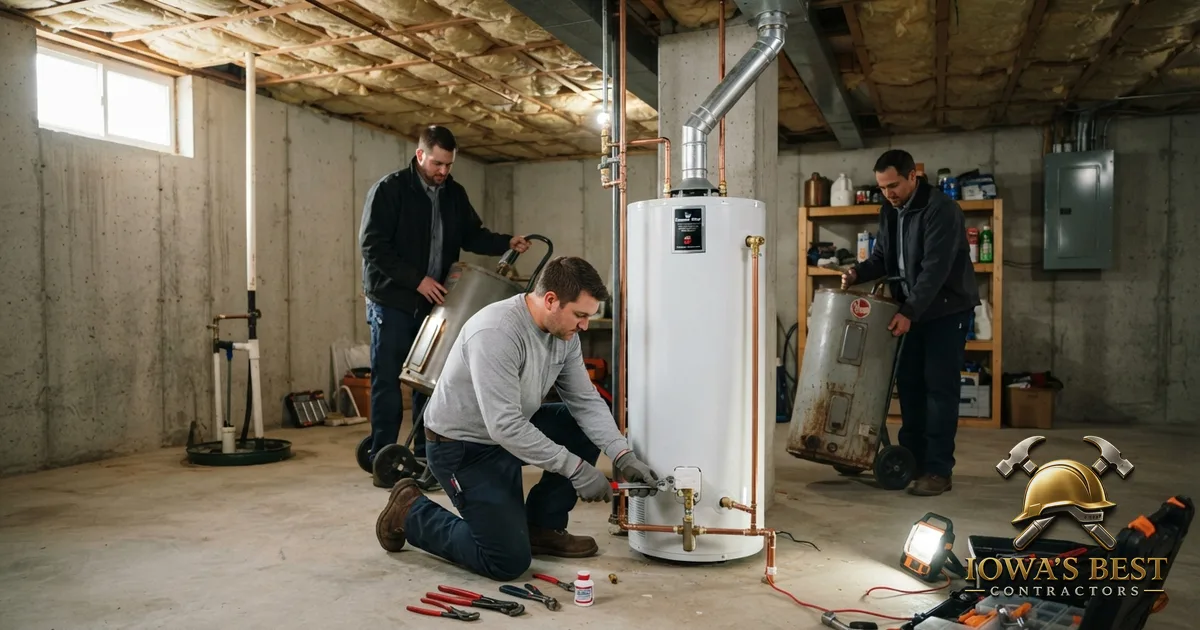
Replacing a water heater in Iowa usually costs between $1,200 and $3,500 installed for a standard tank model, with most homeowners paying $1,600 to $2,600. Tankless units run higher, often $3,000 to $6,000 installed. Your final number depends on the type and size of unit, the fuel source, and how much your existing setup needs to be brought up to code. Here is a plain-English breakdown so you can budget with confidence.
Typical water heater replacement costs in Iowa
Price hinges most on the type of unit and its capacity. Here is how the common choices tend to shake out, installed:
- Standard gas tank (40 to 50 gallon): roughly $1,400 to $2,600. The most common replacement in Iowa homes.
- Standard electric tank (40 to 50 gallon): roughly $1,200 to $2,400. Often a bit cheaper on the unit but slower to recover.
- Tankless (on-demand) gas: roughly $3,000 to $6,000. Higher upfront cost, but endless hot water and a smaller footprint.
- Heat-pump (hybrid) electric: roughly $2,500 to $4,500. Very efficient, though it needs a warm, roomy spot like a utility area.
These are ranges, not quotes. Costs vary with your home's plumbing, gas or electrical work, permit fees, and local labor rates, so always get an itemized estimate.
What factors affect water heater replacement cost?
Two homes on the same street can get very different bids. The biggest cost drivers are:
- Fuel type and switching. Staying with the same fuel is cheapest. Converting electric to gas (or the reverse) adds venting, gas line, or electrical work.
- Code upgrades. Older Iowa homes may need a new expansion tank, updated venting, a drip pan, or an upgraded shutoff to meet current code.
- Location and access. A tight basement corner or an attic install takes longer than a garage swap.
- Capacity. Moving from a 40 to a 50 or 75-gallon tank for a bigger household raises the unit cost.
- Haul-away and disposal. Removing the old tank is usually included, but confirm it in writing.
Iowa-specific considerations
Iowa's hard winters and hard water both affect water heaters. Incoming groundwater is cold for much of the year, so your heater works harder to reach temperature, which is one reason properly sized units matter here. Much of Iowa also has hard water, and mineral scale is the number one enemy of a water heater. Sediment buildup shortens tank life, reduces efficiency, and can cause that rumbling or popping sound in an aging unit.
If your home has hard water, ask your plumber about a water softener and plan to flush a tank heater once a year. Tankless units are especially sensitive to scale and should be descaled periodically. In an unheated or barely heated space, make sure the unit and nearby pipes are protected so a deep freeze does not cause a burst. A quality install with the right venting and a drip pan protects both the equipment and your basement.
Signs it is time to replace
A typical tank water heater lasts 8 to 12 years in Iowa; tankless units often last 15 to 20 with maintenance. Watch for these signs:
- Rusty or discolored hot water, or rust around the tank base.
- Water pooling under or around the unit.
- Popping, rumbling, or knocking noises from sediment.
- Hot water that runs out faster than it used to.
- The unit is past 10 years old and needing frequent repairs.
As of this guide's September 2026 update, replacing a standard 40 to 50 gallon tank water heater in Iowa runs about $1,200 to $3,500 installed, with most homeowners paying $1,600 to $2,600; a tankless gas unit runs $3,000 to $6,000 and a heat-pump hybrid $2,500 to $4,500. Staying with the same fuel is cheapest, because switching between gas and electric adds venting, gas-line or electrical work. Older Iowa homes often need code upgrades such as an expansion tank or updated venting, and hard water shortens tank life, so ask each plumber for an itemized estimate that names the unit, the code work and the haul-away, and confirm the contractor is registered with the State of Iowa under chapter 91C.
How to choose a plumber
The lowest bid is rarely the best value. Compare at least two or three written estimates and look at what each includes, not just the bottom line. A trustworthy plumber will:
- Provide an itemized estimate covering the unit, removal, permit, any code upgrades, and labor.
- Pull the required permit and, in most Iowa cities, arrange inspection.
- Carry liability insurance and show you proof.
- Be registered with the State of Iowa as a contractor.
You can confirm registration and compare local pros on our directory of Iowa plumbing, heating, and air conditioning contractors. Every business listed appears on the State of Iowa's official registration record under chapter 91C, and we never take payment for placement. In a metro like Des Moines you can narrow straight to Des Moines plumbing, heating, and air conditioning contractors. Keep in mind that state registration is not a license or an endorsement; it simply confirms the contractor is properly registered to work in Iowa.
How many plumbing and HVAC contractors are registered in Iowa?
As of September 2026, 1,309 contractors are registered with the State of Iowa under the trade Plumbing/Heating & A/C Contractors. The largest concentrations are in Des Moines (67), Cedar Rapids (40), Sioux City (28), Ames (27), Davenport (27). The statewide list covers every county, alphabetically, straight from the public record.
Registration is a compliance record with the State, not a rating of quality, so use the list to build a shortlist and compare itemized bids from at least three of them.
Frequently asked questions
Is tankless worth it in Iowa?
It can be. Tankless units deliver endless hot water and save space, and they last longer than tank models. The tradeoff is a higher upfront cost, and Iowa's cold incoming water means you need a properly sized unit. For many households a quality tank heater is still the better value.
Do I need a permit to replace a water heater?
Usually yes. Most Iowa cities require a permit and inspection for a water heater replacement, especially when gas or venting is involved. A reputable plumber pulls the permit as part of the job. Ask who is responsible before signing.
How long does the installation take?
A straightforward tank-for-tank swap typically takes two to three hours. Fuel conversions, tankless installs, or jobs with code upgrades can take a full day or more.
Can I install a water heater myself?
Gas connections, venting, and permits make DIY risky and often out of code in Iowa. An improper install can cause carbon monoxide, gas leaks, or water damage. For a job this important, a registered pro is the safer choice.
How much does water heater replacement cost in Iowa?
As of September 2026, a standard tank replacement runs about $1,200 to $3,500 installed in Iowa, with most homeowners paying $1,600 to $2,600. Tankless units run $3,000 to $6,000 and heat-pump hybrids $2,500 to $4,500. Fuel switching, code upgrades and awkward access are what push a quote toward the top of the range.
Ready to get accurate plumbing bids?
The best way to know your real number is to get multiple itemized quotes from registered local pros. You can collect bids from registered contractors in minutes, or browse registered plumbing, heating, and air conditioning contractors across Iowa to build your shortlist. A little comparison up front protects both your home and your wallet.