
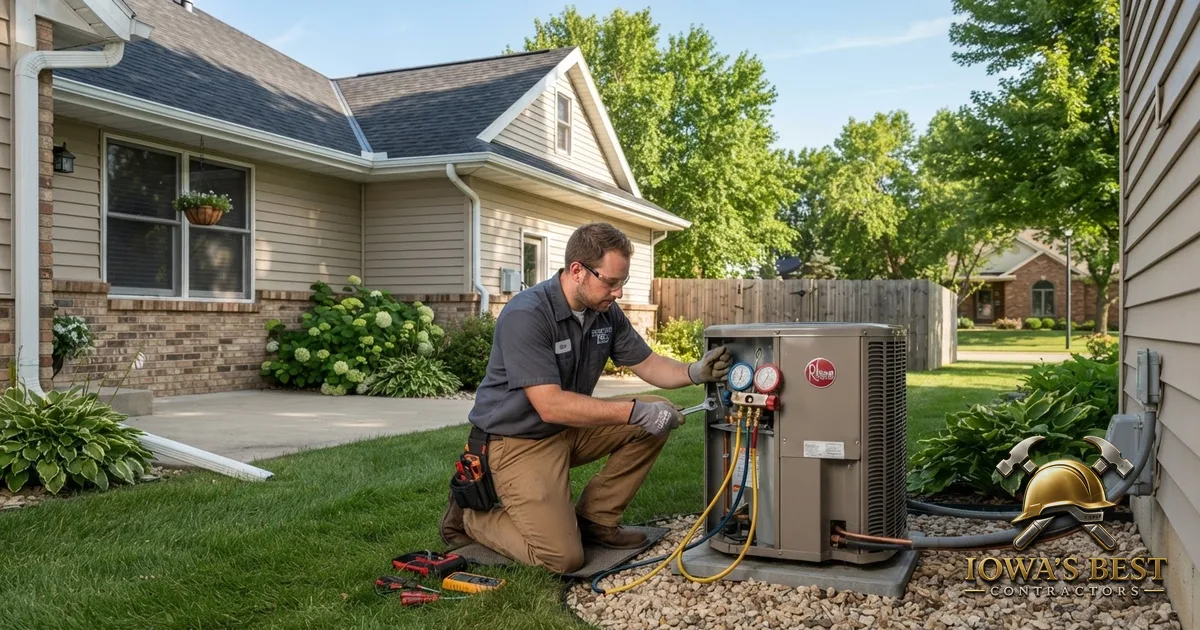
The best HVAC contractor for your Iowa home is state-registered, holds an active mechanical license from the Iowa Plumbing and Mechanical Systems Board, carries liability and workers' comp insurance, and provides local references for similar work. Iowa requires real licensing for HVAC—not just registration—so verify credentials before you sign.
What makes an HVAC contractor "the best" in Iowa?
The best HVAC contractor for your project is licensed by the Iowa Plumbing and Mechanical Systems Board, state-registered under Chapter 91C, insured, and experienced with Iowa's climate extremes. Unlike general contractors—who only need registration—HVAC professionals must pass a state licensing exam that tests knowledge of mechanical systems, codes, and safety. That license is your assurance the contractor knows how to size, install, and service heating and cooling equipment correctly. Registration confirms they carry unemployment insurance and workers' comp; licensing confirms they have the technical skills. Both matter, but licensing is the higher bar.
Iowa winters hit -20°F and summers top 100°F, so your furnace and AC work harder than in milder states. A contractor who understands Manual J load calculations, proper ductwork sizing, and refrigerant handling will save you money on utility bills and prevent breakdowns. Ask for references from jobs in your county, especially if you're in a rural area where service response time matters. The "best" contractor is the one who shows up when your furnace quits on a January night—and who installed it right in the first place.
How do I verify an HVAC contractor's Iowa license?
Every legitimate HVAC contractor in Iowa holds a mechanical contractor license you can verify online. Visit the Iowa Plumbing and Mechanical Systems Board website and search by business name or license number. The lookup shows the license status, expiration date, and any disciplinary actions. If the license is expired or the contractor can't provide a number, walk away. You should also check their state registration at Iowa Workforce Development's contractor registry—both credentials are required by law.
Don't confuse registration with licensing. Registration under Chapter 91C proves the business carries workers' comp and unemployment insurance, but it doesn't test technical competence. The mechanical license is the exam-based credential that proves the contractor knows Iowa's mechanical code and can legally install or repair HVAC systems. A contractor who's registered but not licensed cannot legally touch your furnace or AC. If someone tells you they're "certified" or "qualified" without showing a state license number, that's a red flag.
What questions should I ask an HVAC contractor before I hire?
Start with licensing and insurance. Ask for the mechanical contractor license number and verify it with the state board. Request proof of general liability insurance and workers' compensation coverage—your homeowner's policy won't cover an uninsured worker who gets hurt on your property. Then ask about experience with your specific system type: furnaces, central AC, heat pumps, ductless mini-splits, or geothermal. Not every contractor services every system, and Iowa's propane and natural gas mix means fuel-source experience matters too.
Get details on the equipment they recommend. Ask why they're proposing a particular brand, efficiency rating (SEER for cooling, AFUE for heating), and size. A contractor who suggests the same 3-ton unit for every house without doing a load calculation is guessing. Ask about warranty coverage—both the manufacturer's equipment warranty and the contractor's labor warranty. Finally, confirm they pull permits for installations. If they say permits aren't needed, that's either ignorance or dishonesty; most Iowa cities require mechanical permits for HVAC replacements.
As of September 2026, Iowa law requires HVAC contractors to hold both a mechanical contractor license from the Iowa Plumbing and Mechanical Systems Board and state registration under Chapter 91C. The license confirms technical competence through a state exam; registration confirms insurance compliance. Homeowners should verify both credentials online before signing a contract, request proof of liability and workers' comp insurance, and compare at least three written bids that itemize equipment specifications, labor, and warranty terms. Proper licensing and insurance protect you from liability and ensure code-compliant work that will pass inspection and perform reliably through Iowa's temperature extremes.
How do I compare HVAC bids in Iowa?
Collect at least three written bids and compare them line by line. Each bid should list the equipment brand and model number, efficiency ratings (SEER, AFUE, HSPF), labor cost, permit fees, and warranty terms. If one bid is significantly lower, ask why—it might use a cheaper brand, skip necessary ductwork modifications, or omit the permit. The lowest bid isn't always the best value if it means a furnace that breaks down in three years.
Pay attention to what's included. Does the bid cover removal and disposal of the old equipment? Ductwork inspection and sealing? Thermostat upgrade? Start-up and system balancing? Some contractors lowball the equipment price but charge extra for essentials. Ask how they size equipment—if they didn't measure your home or ask about insulation, window count, and sun exposure, they're not doing a proper load calculation. An oversized furnace or AC cycles on and off too often, wasting energy and wearing out faster. An undersized system won't keep you comfortable.
Here's what to compare across bids:
| Item | What to Check |
|---|---|
| Equipment brand & model | Verify efficiency ratings and warranty length |
| Labor & installation | Should include ductwork inspection, start-up, balancing |
| Permits | Confirm contractor pulls them; cost should be itemized |
| Warranty | Equipment warranty (manufacturer) + labor warranty (contractor) |
| Timeline | Start date, completion estimate, weather contingencies |
What are the most common HVAC problems in Iowa homes?
Iowa's temperature swings stress HVAC systems harder than moderate climates. Furnaces run for months straight in winter, and central AC units work overtime in humid July and August heat. The most common failure points are blower motors, capacitors, and heat exchangers on furnaces, and compressors and refrigerant leaks on AC units. Dirty filters and neglected maintenance accelerate wear—if you haven't changed your filter in six months, you're asking for a breakdown.
Ductwork issues are widespread in older Iowa homes. Leaky ducts in an unconditioned attic or crawlspace waste 20–30% of your heated or cooled air, spiking utility bills and making some rooms uncomfortable. A good HVAC contractor will inspect ducts during installation and recommend sealing or insulation upgrades if needed. Undersized or oversized equipment is another common problem, usually the result of a contractor who didn't do a load calculation. If your system runs constantly but the house stays cold, or cycles on and off every few minutes, sizing is likely the culprit.
Where do I find licensed HVAC contractors in Iowa?
Start with Iowa's Best Contractors, where you can search the full list of state-registered HVAC and mechanical contractors. The directory links to each contractor's registration details, so you can verify their status before you call. From there, check their mechanical license with the Iowa Plumbing and Mechanical Systems Board, ask for references, and request written bids. You can also search by county if you want to find contractors near you.
Don't hire based on a truck magnet or a door hanger. Iowa law requires HVAC contractors to be licensed and registered—verify both before you sign anything. If you're comparing contractors across trades for a larger project, explore the full trades directory to see who's registered for each type of work.
Frequently asked questions
Does Iowa require HVAC contractors to be licensed?
Yes. HVAC contractors in Iowa must hold a mechanical contractor license issued by the Iowa Plumbing and Mechanical Systems Board, which requires passing a state exam. They must also register with Iowa Workforce Development under Chapter 91C. Registration alone is not enough—mechanical work requires the board license.
How much does HVAC work cost in Iowa?
Furnace replacement typically runs $3,000–$7,000, central AC installation $3,500–$8,000, and heat pump systems $5,000–$12,000, depending on size, efficiency, and ductwork. Service calls and repairs generally cost $150–$500. Get at least three written bids that itemize equipment, labor, and warranty terms.
What should I check before hiring an HVAC contractor in Iowa?
Verify their mechanical contractor license with the Iowa Plumbing and Mechanical Systems Board and their state registration with Iowa Workforce Development. Ask for proof of liability and workers' comp insurance, get references from recent jobs, and confirm they pull permits for installations. Compare at least three detailed written bids.